


Entrepreneurship is not really a job. That is the first lie people tell themselves.
From the outside, it can look like a cleaner way to make money: more freedom, more upside, more control, maybe even a better schedule one day. And yes, if things go well enough for long enough, some of that can become true. But in the beginning, and for a very long time after the beginning, entrepreneurship is mostly a choice to live inside chaos. It is choosing uncertainty when certainty was available. It is choosing risk when a good paycheck was already on the table. It is choosing to wake up every day with a problem that belongs entirely to you.
The strange part is that real entrepreneurs would usually choose it again. That is why I believe entrepreneurship is a lifestyle.
I know that phrase can sound cheesy. It can sound like something printed on a coffee mug or posted by someone who confuses being busy with being useful. But I mean it in the more honest sense. Entrepreneurship follows you everywhere. It changes how you think, how you sleep, how you spend money, how you handle stress, how you look at opportunity, and how much uncertainty you can tolerate before breakfast. It is not something you clock in and out of.
There is a certain type of person who looks at a steady job, a predictable income, a respectable title, good benefits, and a relatively normal life and thinks: this is nice, but I do not think this is mine. That is the part most people do not understand. It is not always about ego. It is not always about money. It is not even always about some grand vision of changing the world. Sometimes it is much simpler and more irrational than that. Some people need to write their own story.
Dexter Holland is a great example. To most people of my generation, he is the lead singer of The Offspring, one of the great punk rock voices of the 1990s and 2000s. But he is also a molecular biologist with a PhD from USC, which is not exactly the standard rock star résumé. Most people would have picked a lane, built a respectable career, and explained away the other part of themselves as a hobby. He did not. He became the punk rocker and the scientist.
That is the thing about people who build. They are often not choosing between two clean options. They are refusing to accept that the options are fixed in the first place.
I had lunch recently with a lawyer who had spent around 20 years in a stable, well-paying role. Good money. Serious career. The kind of job most people would tell you not to walk away from. And yet there he was, deciding to go out on his own. Not because he had every answer, or because the clients were guaranteed, or because the spreadsheet said it was the safest move. He was doing it because at some point, after enough years inside someone else’s structure, the risk of staying can start to feel bigger than the risk of leaving.
That is a very founder thing. People outside the arena tend to measure risk incorrectly. They look at the paycheck, the title, the office, the benefits, and they assume the safe path is obvious. But for some people, the bigger risk is spending another 10 or 20 years becoming excellent at something that no longer feels like theirs.
The older I get, the more I respect the people who actually try. Not the people who talk about trying, or the people who have opinions from the sidelines, but the people who put their name, money, reputation, marriage, sleep, and sanity into something that may or may not work.
I have a friend who is a chef, and I have watched him build his restaurant up close enough to understand the work. He built the place. He worked on the tables. He came up with the menu. He created his own weird, personal, ambitious concept and then had to live with it every single day. I secretly cheer for him and respect the hell out of him because he chose to build something. He took the risk, worked the hours, carried the stress, and now, after all of that, he has been recognized by the Michelin Guide. Hopefully, one day, he gets the star too.
That is the part people miss when they look at entrepreneurship from the outside. They see the award, the article, the full dining room, the acquisition, the big exit, the LinkedIn announcement. They do not see the years where the whole thing looked fragile, expensive, obsessive, and maybe a little insane.
When you are also an entrepreneur, you learn to clap for those people. You clap for the guy who got the Michelin recognition. You clap for the founder who had the million-dollar exit. You clap for the person who made it after everyone quietly assumed they probably would not. But you also clap for the guy who failed, got his shit back together, walked back outside, and decided to face the world again.
Maybe that deserves the loudest applause, because winning is hard, but starting over after the market has already punched you in the face is a different kind of courage. That is not optimism anymore. That is scar tissue. That is pride, humility, delusion, discipline, and survival all mixed together.
You clap because you know the odds were against them. You know how hard it is to make anything work. And you know that most of them, even after they win or lose, will probably go do something crazy again. Maybe it works the next time. Maybe it does not. That is the sickness. That is the lifestyle. That is also the beauty of it.

I understand that feeling because I had the comfortable job. I had the good paycheck and the flexible days. Some days I worked two hours, some days six, some days twelve. It was a good life on paper. But it was not my risk. It was not my decision. It was not my business. At some point, that started to matter more than the comfort.
So I left the version of life that made sense and walked into one that did not. I went from finance, marketing, business intelligence, and technology into learning how beef, seafood, pork, and poultry actually move through the world. How products are sourced. How restaurants buy. How customers think. How logistics break. How margins disappear. How hard it is to sell something perishable, expensive, emotional, and operationally complicated.
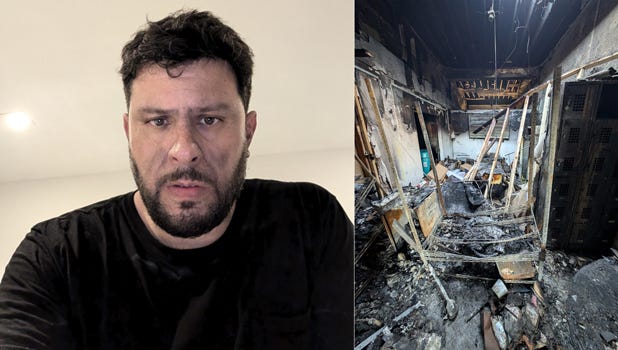
I did not grow up in the meat business. I chose to learn it. And like most things in entrepreneurship, the education was not clean. It came through mistakes, fires, cash pressure, supplier problems, bad hires, good hires, spoiled product, angry customers, small wins, big bets, and the occasional miracle that arrived three hours later than you needed it. That is the real school.
My business partner Gabriel could have had a very normal software career: a good job, good work, good pay. Instead, he has spent years working like a maniac trying to build something that may or may not work. That last part matters: may or may not work.
“As a startup CEO, I slept like a baby. I woke up every 2 hours and cried”
— Ben Horowitz
People love to talk about entrepreneurship after the outcome is known. Once the company sells, once the round closes, once the restaurant is packed, once the brand becomes obvious, everyone rewrites the story as if it was always inevitable. It was not. In the middle, it usually looks stupid. In the middle, it looks like capable people with good résumés making their lives harder than they need to be. It looks like missed weekends, delayed vacations, strained relationships, awkward bank balances, and a constant low-grade hum of anxiety.
Entrepreneurship is often described as freedom, and that is partly true, but only if we are honest about the definition. It is the freedom to be responsible for everything. The freedom to have payroll due. The freedom to have customers complain directly to you. The freedom to find out that your great idea still needs permits, insurance, working capital, distribution, training, tax filings, and someone willing to answer the phone when things go wrong.
Be Horowitz joked that entrepreneurship is akin to sleeping like a baby, you are the wakes up crying in the middle of the night. That is funny because it is too close to the truth. And yet, the real ones keep going.
Even when it fails, many of them try again. Maybe not immediately. Maybe not with the same optimism. Maybe after some scars, some debt, some humility, and a slightly better understanding of how the world actually works. But they try again, because entrepreneurship is not just a vehicle for making money. It is a way of being in the world.
That does not mean everyone should do it. In fact, most people probably should not. There is nothing wrong with a great job, a steady career, or being excellent inside a company someone else built. But if you are going to become an entrepreneur, really become one, you should understand what you are signing up for. You cannot treat it like a side project forever. You cannot be half-in and expect the market to reward you like you are all-in. You cannot romanticize ownership and then resent responsibility.

At some point, the business demands a level of commitment that is hard to fake. Customers can feel it. Employees can feel it. Investors can feel it. Your family can definitely feel it. This is why part-time entrepreneurship rarely works unless the ambition is also part-time. If what you want is a small investment, a passive income stream, or a franchise where the playbook is already written, that can be perfectly fine. Buy the Subway. Follow the manual. Optimize the box.
But building something from zero is different. There is no manual. Or worse, there are 50 manuals and half of them are wrong. That is what makes it brutal. It is also what makes it beautiful.
The entrepreneur is not always the smartest person in the room, not always the best educated, and not always the most talented. But the entrepreneur has a strange tolerance for ambiguity, a strange relationship with pain, and a strange belief that tomorrow can be bent, even if today is punching them in the face.
That is the lifestyle. Not the podcast version. Not the LinkedIn version. Not the airport lounge selfie version. The real version. The version where capable people walk away from comfort because comfort starts to feel like a cage. The version where a punk rocker can also be a molecular biologist. The version where a lawyer leaves a safe salary after 20 years because he wants his name on the door. The version where a chef builds the tables, writes the menu, opens the restaurant, and earns the recognition. The version where a finance guy decides to learn meat. The version where a software engineer trades clean code for messy operations because the company is his.
It is irrational, exhausting, expensive, and lonely in ways that are hard to explain. And for the people wired this way, it is still the only thing that makes sense, because the dream is not just to win. The dream is to know that, win or lose, the story was yours.
Dexter Holland said it best in his USC commencement speech: “Life is not a straight line, but a series of pivots.” His line works because it is not just a nice graduation quote. It is the operating reality of anyone who builds something from nothing. You make a decision, learn from the consequences, adjust, and try again. Some pivots are chosen, some are forced, some are brilliant, some are expensive, and some look irrational from the outside until years later.
The real ones were never looking for a straight line.
They were looking for a life that was theirs.
Luis Mata
Flavor & Founders