


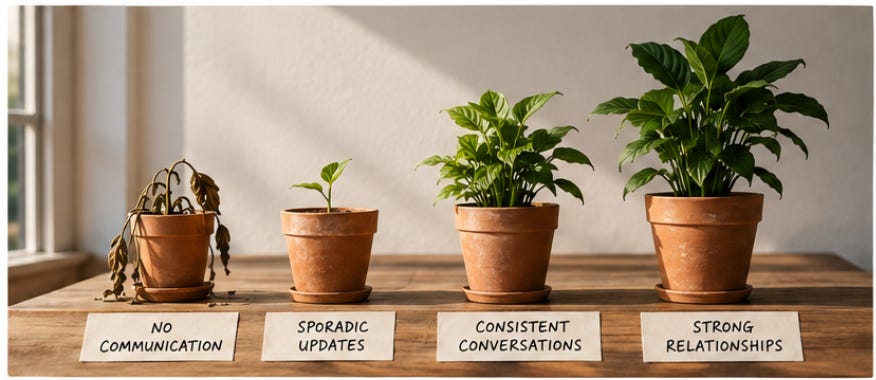
A friend of mine, Barry Kates, likes to say that we are only as good as our relationships. The longer I run a company, the more I think he is right, but not necessarily for the obvious reason. The hard part is not understanding that relationships matter. Every founder learns that quickly. The hard part is that, as the company grows, the communication around those relationships begins to consume an enormous amount of time.
When we started Meat N’ Bone, I thought the job was to build the company: find customers, hire people, raise money, negotiate with suppliers, solve problems and keep moving.
Over time, the business accumulated a much larger circle around it. Investors, advisors, board members, partners, suppliers, bankers, lawyers, employees, former employees, customers and people who have helped us along the way. Many of the most important things that have happened to us came through those people. A supplier relationship changed a category for us. An introduction created a financing opportunity. An advisor opened a door we did not know existed. When you look back, the company was shaped as much by people as it was by strategy.
But relationships are like plants. You have to water them. And whether you like it or not, a big part of the founder’s job is watering those plants.
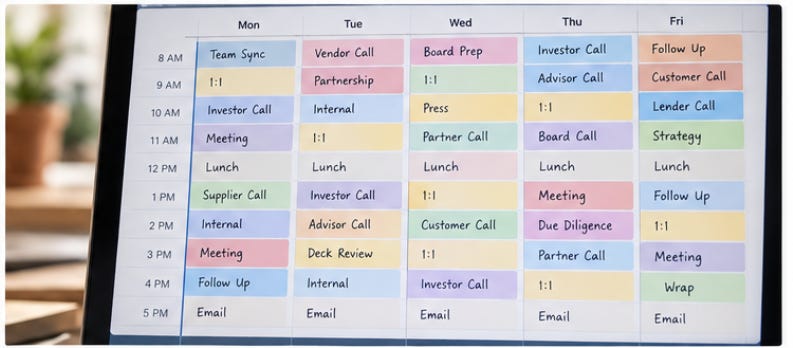
The problem is that there is a difference between maintaining relationships and maintaining the machinery around those relationships. I have never liked meetings. Most meetings could probably be an email. Corporate life has a way of turning meetings into the default solution for everything. Someone has an idea, schedule a meeting. There is a problem, schedule a meeting. Someone needs an update, schedule a meeting. Before long, your calendar is full, you are exhausted by Friday, and you have spent most of the week talking about the business rather than moving it forward.
That is why I do not have recurring one-on-ones with my staff. We talk when there is something worth talking about. Our senior team meets formally once a week for an hour, and the objective is simple: what matters, what is stuck, what needs a decision, and where does someone need help. Beyond that, if something can be resolved in an email, I would rather it be an email. My time has to be reserved for the things where my involvement can actually change an outcome: a major partnership, a supplier relationship, a financing, a key hire, a strategic problem or, increasingly, building tools.
AI has made that last part much more interesting for me. I am not a software engineer, but I know our business well enough to know where information gets lost, where people repeat work and where a process exists only because nobody has taken the time to replace it. What I have noticed is that one of the biggest areas of repetition is not operations. It is communication.
An investor update is a good example. You write it, send it by email, attach the latest deck or financials, and twenty people receive it. Some read it, some skim it, some miss it. One replies by email, another texts you, and a month later someone asks you to resend the deck. Then you repeat some version of the same process for your advisors, your board, a lender, a potential investor or a strategic partner. The information is largely the same, but the audience and context are different. The CEO ends up in the middle, continually repackaging and redistributing the same story, or some variation of it.
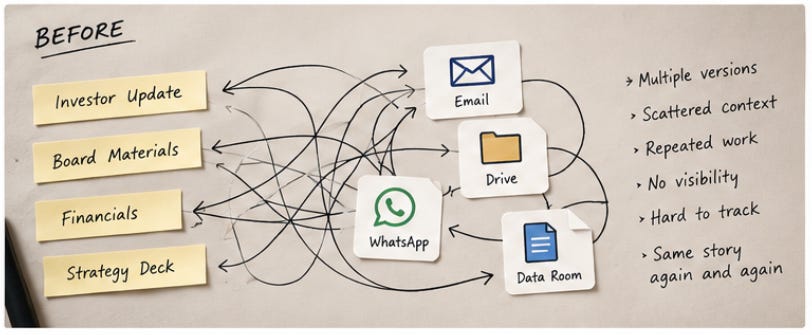
I think that is where the real inefficiency lives. Email is excellent at sending information, but poor at maintaining context. Attachments become outdated, threads disappear, people work from different versions, and when you finally get on a call, part of the conversation is spent reconstructing what everyone should already know. The meeting itself may be valuable. The waste is everything required to get everyone to the point where the meeting becomes useful.
I do not want fewer relationships, and I do not want software to manage them for me. I still need to call people, have dinner with them, listen, ask for advice, make introductions and build trust. What I want is a better way to manage the information around those relationships so the conversations become more productive.
I want to be able to share an update once instead of rewriting it twelve times. I want people to see the right information for their role without digging through old emails. I want the latest deck to actually be the latest deck. I want to know whether someone saw something important before I speak with them, and I want to understand what resonated, what created concern and what deserves a deeper conversation.
That is the problem I have been thinking about lately, and it is the reason I started building something.
For now, I am calling it Inner Room.
I am not ready to talk much about the product yet because I am still using it, changing it and learning what actually solves the problem. But the idea behind it is simple enough: the people closest to a company should have a better way to stay informed, and the CEO should not have to spend half the week repeating the same context just to keep everyone there.
The best meetings are not the ones where everyone finally gets caught up. They are the ones where everyone arrives already caught up and the real conversation can begin.
One small editorial note: I like the plant analogy, but I would keep it to exactly those two sentences. Any more than that and it starts to feel cliché; at this length, it works.
Luis Mata
Luis Mata is the CEO and co-founder of Meat N’ Bone, CFO & Partner of Olos Impact, and partner of Standard & Scale. He writes about food, founders, capital, technology, and the operating systems behind growing companies.