


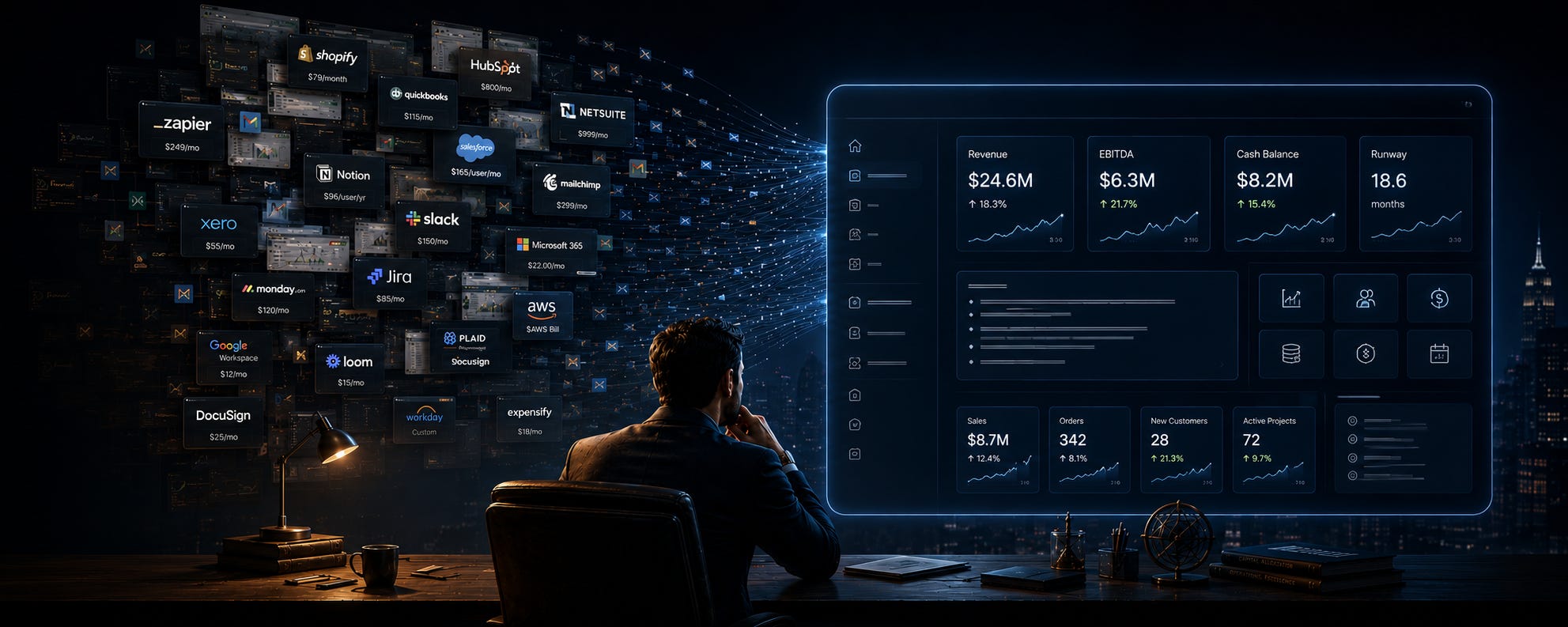
Every new tool you added to the stack was a sign your business was becoming more sophisticated. Scheduling, reporting, dashboards, workflows, tracking, communication… there was a SaaS product for everything, and the more of them you had, the more “built” the company felt.
A few months ago, we started going in the opposite direction.
Not by ripping out core systems, because those still matter, but by chipping away at the long tail: the small subscriptions that quietly accumulate into real money and, more importantly, real friction. Scheduling tools, internal dashboards, reporting layers, routing logic, writing tools, lightweight automations. Over a short period, using a combination of ChatGPT, Claude, and development environments like Replit and Lovable, we replaced roughly $3,000 a month in SaaS.
Not with better software.
With systems that were simply closer to what we actually needed.
That was the moment it clicked for me that this is not just another wave of productivity tools. It is a structural shift, and if you zoom out far enough, it starts to look less like disruption and more like a loop.
Before software, you paid experts because there were no tools. If you needed forecasting, you hired someone who understood forecasting. If you needed operational visibility, someone built you a process, usually in spreadsheets, usually fragile, but tailored to your business.
Then SaaS arrived and changed the equation. Instead of paying for expertise, you subscribed to it. The software became the expert, or at least good enough to replace one. That was the real breakthrough of the SaaS era. It did not just scale software; it scaled judgment. Businesses no longer needed custom-built systems because standardized tools were finally good enough.
The tradeoff, which made complete sense at the time, was that companies slowly stopped building around themselves and started adapting themselves to the software.
I learned this lesson years ago while working at one of the world’s largest education companies. We attempted to build a student retention and behavioral forecasting system designed to predict which students were most likely to stop attending classes or drop out entirely. Its complicated because students will often lie or not disclosed the reasons. The project involved internal teams, outside consultants, long planning cycles, and significant engineering effort. Communication between business stakeholders and technical teams was painfully slow, and translating operational knowledge into software requirements was often harder than building the system itself.
Recently, we built something conceptually similar at Meat N’ Bone in a matter of days.
Using AI-assisted development, we created systems that track customer behavior, sentiment, CAC, LTV, purchase patterns, cross-sell opportunities, and customer archetypes at an individual level. We can identify behavioral signals, segment users dynamically, and build operational dashboards tailored specifically to how our business functions.

A few years ago, a $11 million company would not realistically have had access to this kind of capability without a serious engineering budget. Today, a small team with domain expertise and AI tools can build it in a week.
That changes the equation entirely.
Because AI does not just give companies access to tools. It gives experts leverage.
If you actually understand your business…. your margins, your seasonality, your category mix, your operational bottlenecks, you can now build systems that reflect reality instead of forcing reality into templates designed for everyone else.
A category management platform no longer needs to be generic. A reporting system no longer needs to conform to a standard model. Forecasting, routing, inventory logic, operational workflows—, can now be shaped around how your business actually operates.
The constraint is no longer primarily technical. It is intellectual.
This is why the conversation around “SaaS being dead” misses the point. SaaS is not disappearing, but a large portion of it is becoming interchangeable. What made many SaaS products valuable was not necessarily their uniqueness, but the difficulty of building an alternative. AI is eroding that advantage quickly.
A surprising amount of software, especially in the long tail, is not fundamentally complex. Historically, combining data, workflows, and interfaces into a usable product required enough engineering effort to justify recurring subscription costs. Today, that barrier is collapsing.
Even Satya Nadella has suggested that the traditional concept of business applications may evolve toward AI-driven agents, where much of the logic moves outside fixed interfaces and becomes dynamically orchestrated. That is a polite way of saying that a meaningful portion of what we currently think of as software may no longer need to exist in its present form.
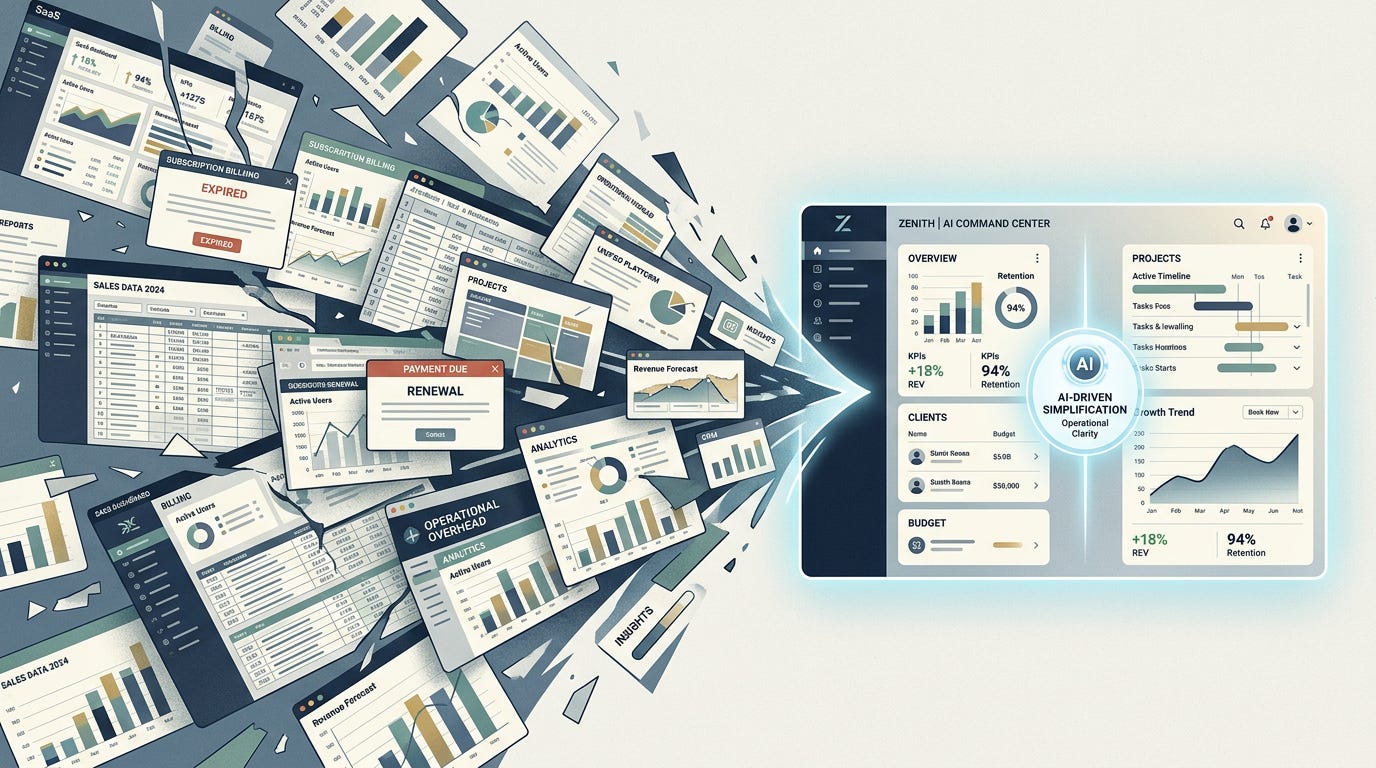
Once that happens, the economics change quickly. Paying for software that does 80 percent of what you need starts to feel far less compelling when you can build something that does 95 percent, specifically for your business.
The impact of that shift will not be evenly distributed. Core infrastructure will remain durable. Payments, compliance-heavy systems, deeply embedded platforms, and systems of record are not easily replaced, nor should they be. The risk of failure is too high and the integration too deep. But everything in the middle begins to feel less secure.
The most exposed layer of the software stack is the one that is useful but not essential, standardized but not deeply integrated, convenient but not irreplaceable. That is where the quiet unbundling is already happening.
There is another layer to this shift that matters just as much, and it has less to do with software than with people.
AI is not just changing what gets built. It is changing who builds it.
Today, a strong developer paired with AI is no longer simply writing code. They are directing it. The AI handles a growing portion of the execution while the human provides structure, judgment, correction, and oversight. The output is often good enough, and increasingly, very good.
That dynamic creates an uncomfortable question for companies: why hire junior developers when AI can already produce similar output instantly?
Many companies are already answering that question by hiring fewer of them.
The problem, of course, is that junior developers are how senior developers are created. They learn by doing the repetitive, unglamorous work that AI is now beginning to absorb. If that layer disappears, the pipeline that produces experienced engineers becomes less reliable over time.
Figures like Jensen Huang have argued that AI will make programming more accessible, effectively allowing more people to “code.” That is likely true in a surface-level sense. But accessibility is not the same as depth. Producing code is not the same thing as understanding systems.
What emerges from this is not a world without developers, but one with fewer, more leveraged ones. The bar rises, expectations increase, and the gap between people who truly understand systems and those who simply use them becomes more pronounced.
The more interesting shift, however, may not happen in engineering departments at all. It may happen in consulting and operations.
For years, if you wanted sophisticated analytics, reporting, or operational tooling, you had two choices. You either built an internal team or hired firms like Deloitte or EY. Both paths were expensive, time-consuming, and often disconnected from the day-to-day realities of the business.
Now, a different model is emerging.
Operators—people who have actually run businesses, managed margins, dealt with operational constraints, and lived inside the complexity—can now build systems themselves. Not perfectly, and not necessarily at enterprise scale, but precisely enough to matter. They can design dashboards that reflect real decision-making, automate workflows that mirror actual operations, and create systems that evolve alongside the business itself.
The advantage is shifting away from access to software and toward clarity of understanding. The companies that win will not necessarily be the ones with the largest software budgets, but the ones that understand their operations deeply enough to build systems around their actual edge.
This is where small teams, or even individuals, begin to compete with much larger organizations. Not because they suddenly have more resources, but because they are closer to the problem and now possess the tools to execute quickly.
The consulting model shifts accordingly. Scale becomes less important than specificity. Speed becomes more valuable than process. Judgment becomes the primary constraint.
If you zoom out, the pattern becomes remarkably clear.
We went from paying experts, to paying software, back to relying on experts—only now those experts can build.
SaaS does not disappear in this world. It stratifies. Commodity tools get squeezed. Mid-tier configurable platforms lose ground. What survives either becomes infrastructure or embeds itself so deeply into workflows that replacing it becomes painful.
Everything else increasingly competes with the possibility that a company simply builds its own version.
The implication is not that every business should suddenly become a software company. That would be inefficient and unrealistic. The implication is that the balance has shifted. Businesses will still rely on external software where scale and specialization matter, but they will increasingly build where differentiation matters.
The winners will not be the companies with the most sophisticated software stacks. They will be the ones with the clearest understanding of their own operations, and the ability to translate that understanding into systems.
SaaS is not dead.
But it is no longer special.
And in a world where software is becoming easier than ever to build, the real edge returns to something much older and much harder to replicate: understanding your business better than anyone else.
Luis Mata
Flavor & Founders