


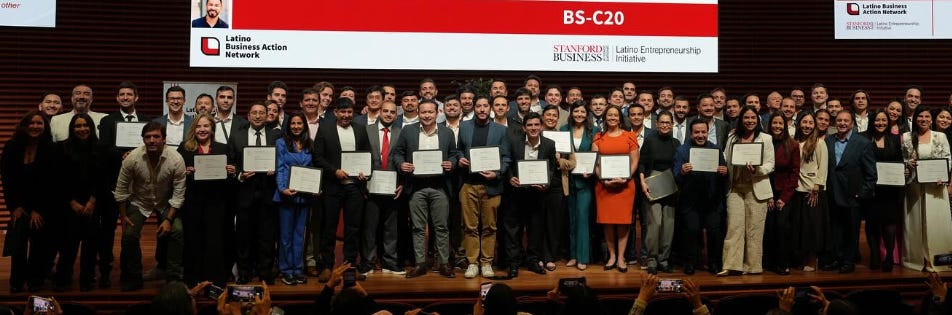
Latino founders are winning. The more uncomfortable truth is that too many people still do not act like it, including us.
Part of the reason I wanted to write this is to amplify what Stanford and LBAN are doing, because this is not one more story dressed up as economics. It is economics.
If U.S. Latinos were their own economy, we would already be the world’s fifth-largest, at roughly $4 trillion in 2023. More striking still, that economy grew from about $2.1 trillion in 2015 to $4 trillion in 2023 — it nearly doubled in eight years.
That should change the tone of the conversation immediately.
This is not a niche market. This is not an emerging constituency. This is not a promising little side pocket of the American economy that deserves encouragement and a nice panel discussion. This is real scale. Real output. Real momentum. If these numbers belonged to a software category, Wall Street would have created a vocabulary for it by now, and venture capital would be hosting dinner series about it in Miami, Austin, and Palo Alto. Instead, Latino entrepreneurship is still too often framed as a social issue when it should be discussed as one of the clearest economic opportunities in the country.
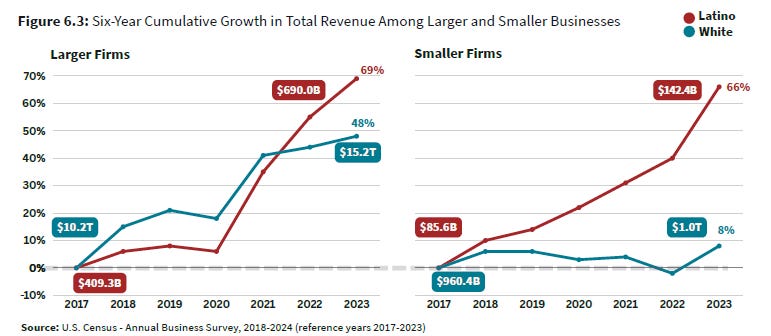
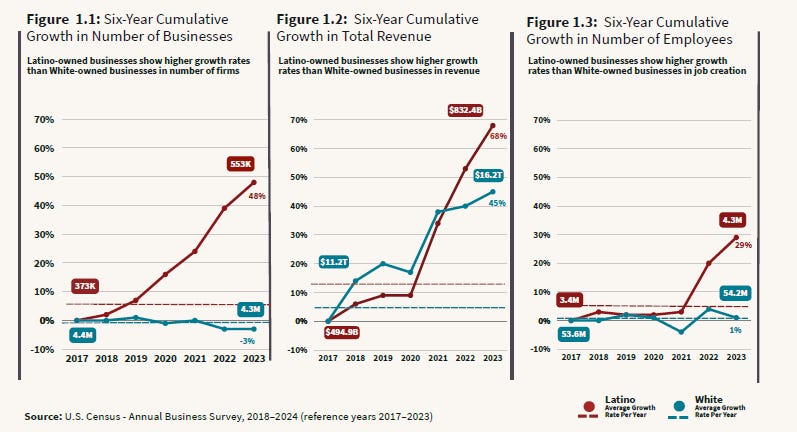
The Stanford State of Latino Entrepreneurship report makes that point in its own way. Latino-owned businesses added 180,000 net new firms between 2017 and 2023, created 976,000 jobs, and grew faster than white-owned firms across firm formation, employment, and revenue. Latino-owned businesses now account for 9.7 percent of U.S. employer firms and generate $832 billion in annual revenue. In any sane market, that kind of performance would attract more early belief than it currently does.
But this is where I think the conversation usually goes soft.
The easy version of this piece would be to say Latino founders are overlooked, underfunded, underestimated, then end with a hopeful note about resilience. There is truth in that, but it is also a little too convenient. It lets everyone off too easily. The system is part of the problem, yes. But so are we.
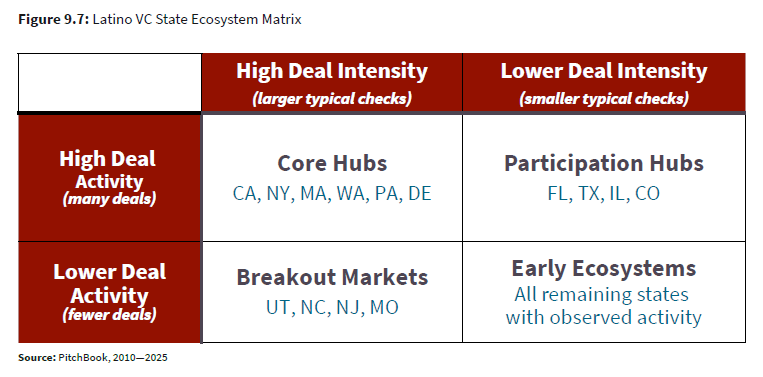
The external version of the problem is real enough. The Stanford report shows that Latino-founded startups posted a median VC deal size of $6 million in 2025, above the U.S. median, even as Latino participation at pre-seed and seed fell sharply. In other words, when Latino founders do get funded, they are often highly competitive. The issue is not that quality disappears when capital arrives. The issue is that too few people get the chance to reach that point.
That is a market failure. But it is not the only one.

The harder truth, and the one I left Stanford thinking about, is that Latinos are often not very good at underwriting each other either. We are strong culturally and weak commercially. We are loud with encouragement and quiet with economic commitment. We celebrate each other on Instagram and then shop against each other like price-sensitive mercenaries.
I see this all the time. I have friends with great jobs, real disposable income, and every ability to support businesses they know are better, more thoughtful, and more aligned with their values. And yet many of them will still hunt down the cheapest possible option to save ten or fifteen percent, sometimes the equivalent of a few dollars a pound, as if this were some heroic act of financial discipline. It is not discipline. Most of the time it is short-term thinking dressed up as savvy. And that behavior adds up. Ecosystems do not scale on applause. They scale on margin.
Full disclaimer: this used to be me too. Today I am happy to pay a premium to support a fellow entrepreneur, because I have come to understand that the premium is often the point. One of the things I loved about LBAN and the summit was seeing how many founders already share that vision. Not performative solidarity. Real alignment.
This is where the comparison to the Jewish community matters. One thing they understand exceptionally well is that community is not just cultural. It is commercial. They support institutions, schools, service providers, retailers, and each other with real economic intent. They are often willing to pay more because they understand they are not just buying a product — they are reinforcing an ecosystem.
Latinos, by contrast, often do the opposite. We love the language of community, but we do not always practice the economics of community. We are less likely to pay for alignment, less likely to keep value circulating inside our own ecosystem, and less likely to treat supporting one another as an investment rather than an expense. That is not because Latinos lack generosity. Far from it. But too often, our support systems are optimized for survival, not for scale.
Survival keeps people afloat. Scale builds institutions.
That distinction matters to me personally because I have lived both the immigrant reset and the entrepreneurial version of it. I came to the United States from Venezuela in high school. My parents were successful business owners back home. Then they came here and had to start again. Competence travels. Status often does not. Reputation does not clear customs. Networks do not transfer neatly.
I watched two very capable people go from established to unknown, from connected to disconnected, from having pull to having almost none. It teaches you quickly that in America, performance matters, but legibility matters too. If the room does not know how to read you, your quality can sit in plain sight for a long time before it becomes investable.
That lesson shaped the way I think about Meat N’ Bone. We bootstrapped a business from zero to roughly $11 million in revenue in a category that is difficult, operationally unforgiving, and very real. Food is not software. You have to execute every day.
By any reasonable standard, a business like that should have a relatively easy time raising growth capital.
And yet it has not been easy.
Part of that is familiar. We did not start with the deepest investor network or the cleanest inherited map of capital. But part of the issue is closer to home too. If our own people do not consistently support quality when it is right in front of them, why would we expect a dense, self-reinforcing Latino business ecosystem to materialize on its own?
Today, I can count on one hand the number of Venezuelans who buy from us. Kind of crazy, isn’t it? Then you see the same people happily spending $500 on an Inter Miami ticket or on 18-year-old scotch.
Thin ecosystems produce talented survivors.
At some point, scale stops being an excuse and starts becoming a responsibility.
No victims here.
The numbers are too strong for that, and frankly so are the entrepreneurs behind them. Latino founders are building, scaling, and proving things the hard way. The question is whether the rest of the market, and whether we ourselves, are prepared to act accordingly.
Because compounding is the whole game.
We need better underwriting from investors and lenders.
We also need better underwriting from ourselves.
Because if U.S. Latinos already represent a $4 trillion economy, and if Latino entrepreneurs are already posting this kind of growth while operating with thinner networks, less inherited capital, and weaker commercial cohesion than they should have, then this story is not close to its ceiling.
It is still the warm-up.
Random though…
FYI: Color coded Calendar… I keep saying I will do this and I never do!
Flavor & Founders