


Let me clear something up before the year ends and we all start pretending we’re brand new people on January 1st.
I don’t need you to be my customer. I don’t need you to “support me.” I don’t need you to root for me like I’m your cousin in the Olympics.
But I do want something from you… something cheaper than a steak and way more valuable: basic decency. Positive vibes. The kind of community energy that makes a city feel human instead of transactional.
Because once you open businesses in public: Meat N’ Bone, then The Wagyu Bar, now The Wagyu House—you learn the hardest part isn’t the market.
It’s watching how people behave when the business belongs to someone they actually know.
Before we get spicy: here’s the whole point
This isn’t a lecture. It’s a New Year’s default setting.
In 2026, cheer louder than you criticize.
If you can’t cheer, at least don’t heckle. Make more friends. The world will be a better place.
And if you can help, help like a grownup: a referral, an intro, a kind word, a little grace.
That’s it. That’s the post.
So… why is that so hard?
The three audiences you meet the minute you open a door
First, there’s the small group that supports you because they genuinely want you to win. They show up, pay full price, bring friends, post the story, and don’t need you to “earn” their goodwill. You never forget them.
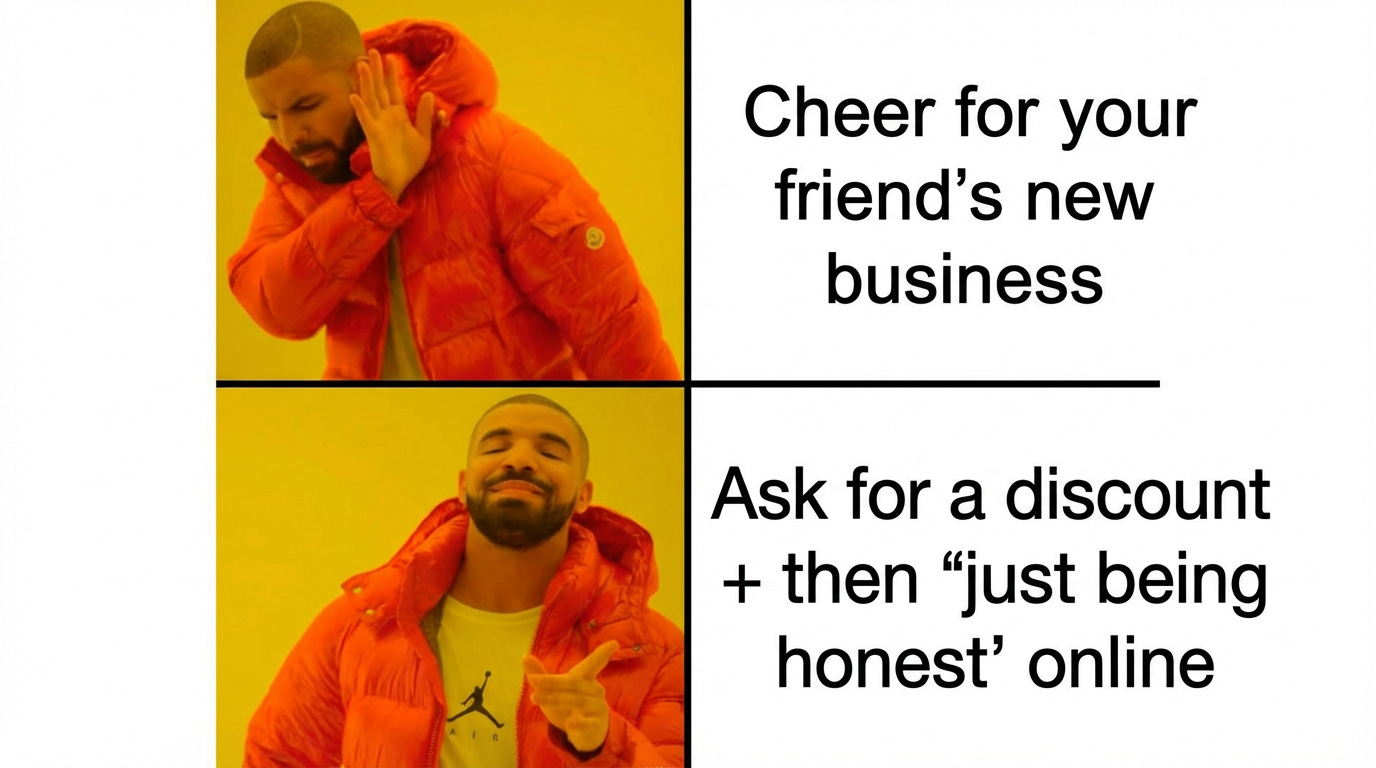
Second, there’s the group that “supports”… with conditions. The friends-and-family discount that somehow becomes a subscription. They’ll spend $80 on Uber Eats from a chain without blinking. They’ll buy the latest Real Madrid jersey for $160 because it dropped this week. But when it’s your business, they suddenly become negotiators: “Come on bro… help me out.” It’s casual, like your margin is a friendship test.
And to be clear: if someone genuinely can’t afford it, that’s a different story. I’m not talking about people dealing with real life. I’m talking about the people who can pay full price—they just don’t want to when it’s you, because they confuse “knowing the owner” with “owning the margin.”
Third, there’s the group you don’t understand until you’ve built something in public: the people who get a tiny thrill out of being unimpressed. They don’t say “congrats.” They say “interesting.” They don’t ask “how can I help?” They ask “what are you doing different?” like they’re on Shark Tank and you’re pitching them a plate of fries. They criticize sometimes even without knowledge (The placed looked empty on an influencer video!)
This isn’t a Yelp post. Yelp is just the easiest microscope slide. The real topic is the behavior underneath it: why some people are quicker to critique than contribute—especially when the person building is close enough to trigger comparison.
The psychology (aka: your brain is running old software)
Here’s a very unromantic reason negativity spreads so easily: bad hits harder than good. It’s one of the most repeated findings in psychology—Roy Baumeister and colleagues summarized it perfectly: “Bad is stronger than good.”
That’s why one negative moment can outweigh ten good ones. That’s why people will go out of their way to write the angry review… and feel like the great night doesn’t require a sentence.
Then layer in loss aversion. Kahneman put it cleanly: “Losses loom larger than gains.” So we’re more motivated to avoid disappointment than to reward excellence. We treat “protecting ourselves” like it’s a public service.
And online, the guardrails come off. Psychologist John Suler’s “online disinhibition effect” explains why people act more extreme behind a screen—anonymity, distance, and low consequence turn normal adults into keyboard gladiators.
So yes… some of this is wiring. Some of this is incentives. And some of it is just… people being weird.
Real-world examples (because you’ve seen this too)
You’ve seen the chef friend who does collabs with everyone except you. Not because the other partner is better. Not because they’re bigger. Just because it’s not you. Collaboration becomes optics: who looks good together, who feels safe to align with, who signals “upward.”
You’ve seen the “allied” brand next door—the obvious partner—who would rather do anything except the obvious cross-promo. They’ll work with someone random across town before they work with the neighbor sharing the same parking lot. Not because it’s smarter. Because partnering with the neighbor is too direct, too equal, too real. If it’s next door, it can’t be packaged as “strategy.” It’s just community.
You’ve seen the “support” that’s really a negotiation. The friend who’s proud of you… as long as you comp the upgrade. The person who “loves your business”… as long as there’s a code. They don’t haggle with Target or Nike. They do it to you because they have access, and access makes people feel entitled.
And then you see them on Instagram paying full price at Papi Steak like it’s a spiritual journey. That’s when you realize it was never about money. It was about the psychology of “I know you.”
The group that bothers me most: the ones who forgot
There are people who have walked in your shoes… and forgot.
They used to be scrappy. They used to be the one praying payroll clears. They used to be the one asking for grace. Now they’re comfortable, and instead of becoming more empathetic, they become sanctimonious.
They love telling you they bootstrapped it. “We built it with nothing.” “No help.” “No shortcuts.” Struggle as a flex.
But the minute you make a mistake… and you do the mature thing, you own it, fix it, apologize… they don’t respond with the grace they once needed.
They respond with leverage.
They threaten you with “destructive reviews,” sometimes while their email signature says something like “Startup Consultant” or “Founder Coach,” like intimidation is a mentorship style.
Not feedback. Not accountability. Destructive. As in: “I’m going to hurt you on purpose, and I’m going to call it honesty.”
That’s not principle. That’s a power fantasy.
This is where Bourdain... He didn’t dress it up. He went straight at the culture of performative criticism, and his “elite Yelper” rant became famous for a reason: it captured the casual cruelty of scoring small businesses like it’s a sport.
And yes, I’ve seen it up close. We’ve had “Yelp Elite” types walk into a boutique, spend five minutes browsing, buy nothing, ask no questions, learn nothing about what we do… and still feel entitled to publish a verdict. Not a conversation. A verdict.

We opened The Wagyu House and got one of those classic “first reviews” during a soft opening—literally within hours. Think about that for a second. Two hours into a soft opening, and someone’s already in the comments acting like they’re auditing a mature operation.
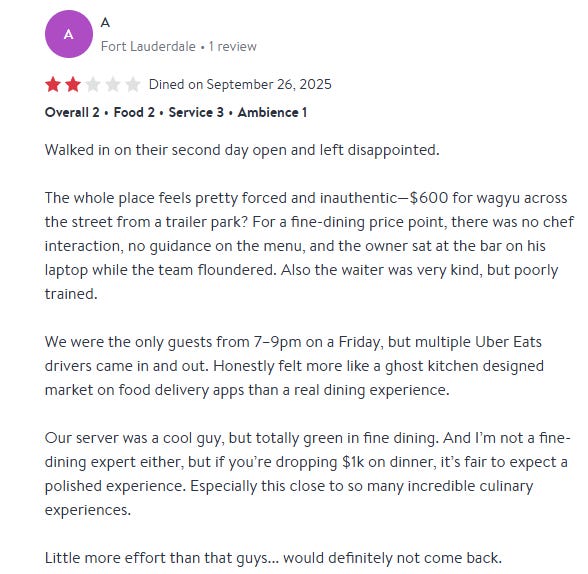
That’s not consumer protection. That’s entertainment.
Again, Yelp isn’t the point. It’s the symptom. The point is what happens when we normalize the idea that small, human businesses exist to absorb our moods.
It’s not just restaurants. It’s every local profession.

Think about the local dentist—. Not the corporate factory where you’re a time slot and a billing code. The real one. Built a practice from scratch, remembers your name, squeezes you in when you’re in pain, invests in equipment, pays a staff, keeps the lights on.
One awkward interaction at the front desk and suddenly it’s “one star, vibe was off.” Not because the dentistry was bad. Because the moment didn’t feel curated.
Now zoom out to medicine. Most people can’t reach their doctor like a normal human relationship. It’s portals, call centers, “please hold,” and an appointment three weeks out. That didn’t happen because doctors forgot how to care. It happened because the system scaled away the relationship.
Same story with pharmacists. We used to have neighborhood pharmacists who knew you, who picked up the phone, who could spot a problem before it became a crisis. Now it’s the same two logos on every corner. Convenience everywhere, connection nowhere.
And this is where the “local” conversation stops being sentimental and becomes structural.
This is how you get a world run by private equity
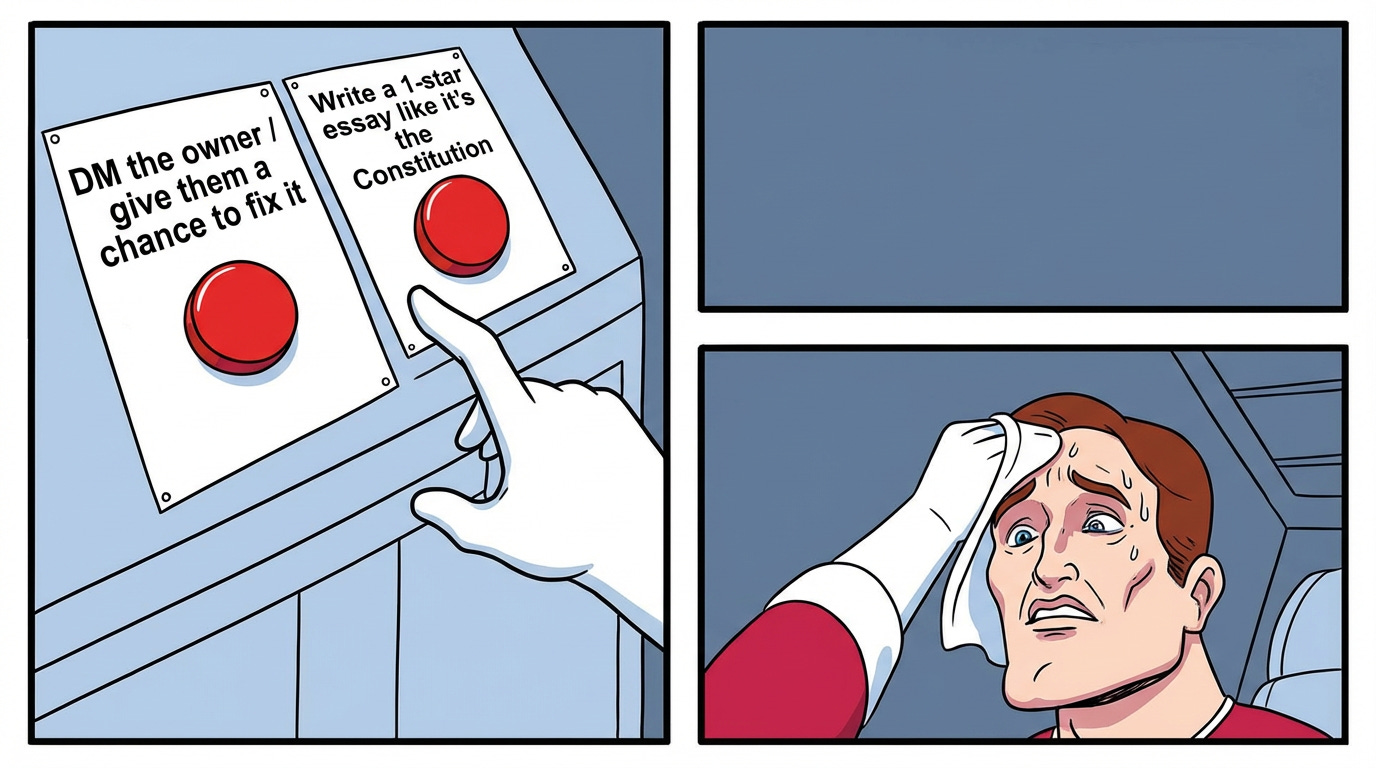
Local businesses don’t die because someone gave feedback. Local businesses die because they don’t have an error budget. They can’t survive a slow week, a public pile-on, a rent increase, and a supplier issue all at the same time.
Meanwhile the real machine moves quietly. Chains scale. Platforms take fees. Roll-ups buy categories. Private equity doesn’t take over the world with a villain speech. It takes over by buying the boring infrastructure that decides what survives: distribution, leases, supply chains, and attention.
So every time we treat the local butcher, baker, chef, dentist, or shop owner like they should operate with Amazon efficiency, Costco pricing, and Ritz-Carlton emotional labor, we’re voting—whether we mean to or not—for the consolidated version of life.
The one where everything is “more convenient” and somehow nothing feels better.
Rivalry isn’t the problem. Petty rivalry is.
Let me say this clearly: rivalry is good. Rivalry is healthy. Rivalry makes people sharper. It forces you to innovate. It raises standards. If you have a competitor who makes you better, that’s a gift.
What’s stupid is the sideways, personal rivalry where the goal isn’t to get better… it’s to make sure the other person doesn’t win. The kind where you root for the new spot to fail because you don’t like the owner, or because they didn’t invite you, or because their success forces you to look at your own excuses.
That’s not competition. That’s insecurity.
Real rivalry says: I see you. I respect you. Now let’s both level up.
My 2026 ask (and it’s cheaper than a coupon)
And to be clear: this isn’t aimed at the people who already show love. You’re the reason “local” still exists. You pay full price. You send the referral. You DM the owner first. You give grace when it’s earned. You don’t treat small businesses like they’re here to absorb your moods.
For everyone else, here’s the year-end ask: you don’t have to support me. You don’t even have to root for me. Just don’t contribute to the world where private equity is the only thing left to support.
In 2026, do the small things that add up: Give a referral. Make an intro. If you know someone who can help someone else, connect them. It costs you nothing and it can change someone’s year.
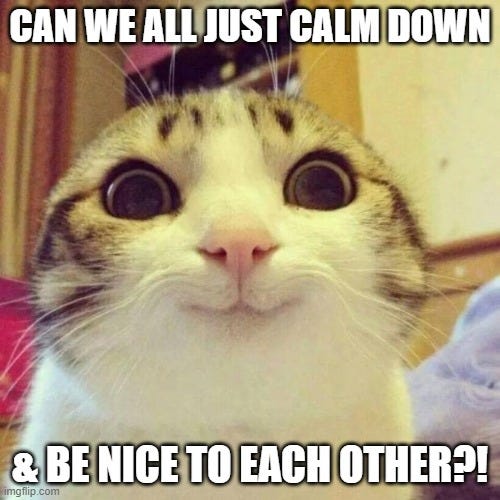
Support local in human ways. Buy a flower from the flower girl outside the gas station—or from the single mom running an e-commerce shop after her day job ends. Smile at the overworked baker at 6 a.m. Be patient with the barista who remembers your name. And if you love a place, say it out loud once in a while—public positivity is oxygen.
And if you have a “rival,” consider that the easiest way to keep your city interesting is to work with the people who are also building. Do the collab. Cross-promote. Share the stage. Compete like professionals, not like teenagers.
Because the future where every street looks the same doesn’t arrive with a bang. It arrives with a million small moments where we chose convenience over community, criticism over kindness, and ego over collaboration.
You don’t have to support me. You don’t have to root for me.
But if you say you love “local,” prove it the one way that matters: when it’s imperfect, when it’s trying, when it’s still becoming.
Because “local” doesn’t die in one dramatic moment.
It dies in a thousand tiny ones… when we choose sarcasm over kindness, commentary over community, ego over collaboration.
In 2026, cheer louder—especially for people you know.
That’s how you keep a city alive.