


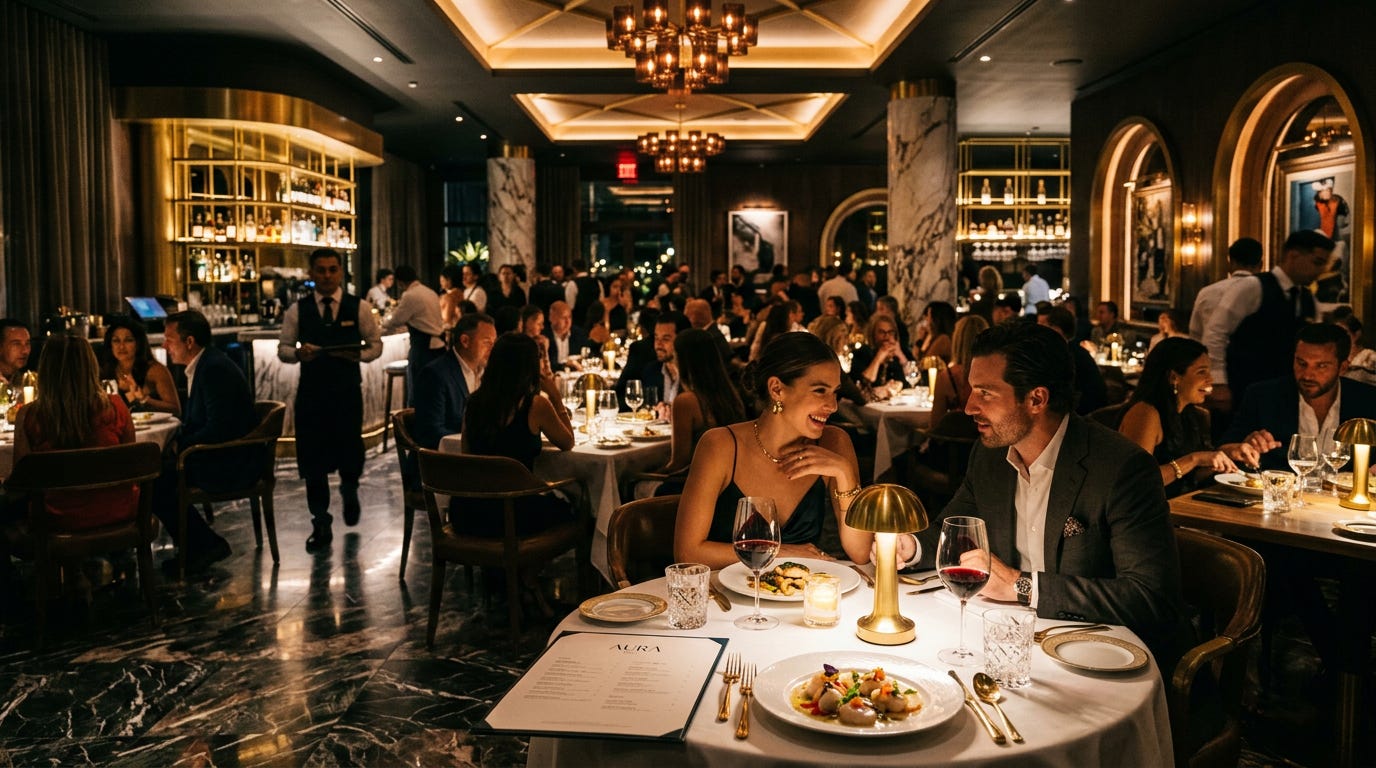
There are two types of people. The ones who go to restaurants for the ambiance, and the ones who go for the food. The best places give you both. Most places give you one and pretend it’s two.
In Miami especially, the trend is obvious. Bigger rooms. Better lighting. Expensive build-outs. Bathrooms that look like they belong in a nightclub in Tokyo. And then the food shows up and it’s… fine. Not bad. Not great. Just familiar in a way you can’t quite explain.
A lot of ambiance. A lot of decor. And increasingly, a lot of Sysco.
That is about to get worse.
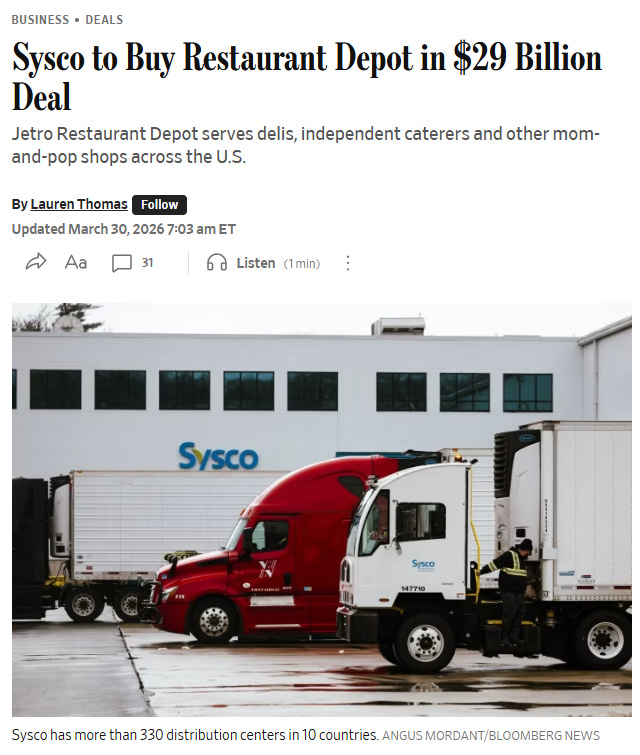
Sysco just announced it is acquiring Restaurant Depot in a deal valued at roughly $29 billion including debt. Restaurant Depot did around $16 billion in revenue last year and operates more than 160 locations across the U.S. On paper, this is about expanding reach into the independent restaurant market, capturing more volume, and generating synergies. That is how it will be framed.
But this isn’t really a story about Sysco. And it’s not really a story about Restaurant Depot either. To be frank, Meat N’ Bone, The Wagyu House and The Wagyu Bar do not source food from Sysco (outside of things like avocados)
To be honest, Restaurant Depot was never a great purveyor. The quality is inconsistent, the experience is chaotic, and half the time you’re buying something because you need it now, not because it’s the best version of it. Anyone who has actually operated a kitchen knows this. Anyone who has experienced Restaurant Depot knows the quality is… cheap.
That’s not the point.
The point is that it was an option.
Jason Perlow (who runs a popular South Florida Facebook group) said it best: “The last real workaround just got absorbed.”
That’s exactly right. For years, a huge portion of restaurants were already tied into Sysco’s ecosystem. That part is not new. What still existed, barely, was a pressure valve. If you didn’t like the pricing, didn’t trust the quality, didn’t want to get pushed into house brands, you could still go around it. You could go to Restaurant Depot. You could source some things yourself. You could mix vendors and keep a little bit of control.
Now that fallback sits under the same umbrella.
So no, this isn’t just consolidation. It’s supply chain capture.
What’s interesting is that this idea is already everywhere online. TikTok, Instagram, reels from “foodies” and cooks and former line guys all saying some version of the same thing: every restaurant tastes the same. It’s all Sysco. Different menu, same food.
A lot of that content is exaggerated. Social media loves a villain, and Sysco has become the easiest one in the industry. But like most internet narratives, it sticks because it’s directionally true.
Not every restaurant is the same. Not the good ones. Not the ones that actually care. But the middle of the market, the part that actually feeds most people, is getting flatter.
Same fries. Same chicken. Same desserts. Same fallback sauces. Same substitutions when something is out. Same “close enough.”
The menu says originality. The supply chain says otherwise.
And here’s the part that gets missed in most of the hot takes: this isn’t happening because chefs suddenly stopped caring. It’s happening because the system rewards it.
Restaurants are not operating from a position of strength right now. Labor is expensive. Rent is out of control. Insurance is worse. Margins are thin. Nobody is making romantic sourcing decisions in that environment. They’re making survival decisions.
Survival looks like fewer vendors. Simpler ordering. Predictable product. Consistent substitutions. Systems that don’t break in the middle of service.
Which means leaning into whatever makes that easiest.
Which increasingly means the same system.
That’s why Restaurant Depot mattered. Not because it was premium, but because it gave operators agency. You could get in your car, walk the aisles, touch the product, and solve your own problem that day. You weren’t fully locked into one distributor’s logic. You had some room to maneuver, even if it wasn’t perfect.
Take that away, or even just weaken it, and the system tightens.
And when the system tightens, the middle compresses.
We’ve seen versions of this before. In 2015, regulators blocked a merger between Sysco and US Foods on the grounds that less competition in food distribution would likely lead to higher prices and worse service. That deal died. This one is different on paper, but the underlying concern doesn’t go away just because the structure changes.
Less optionality tends to lead to more standardization.
Anthony Bourdain said it years ago, in a different context: “If you’re not using the best ingredients, you’re not cooking. You’re assembling.”
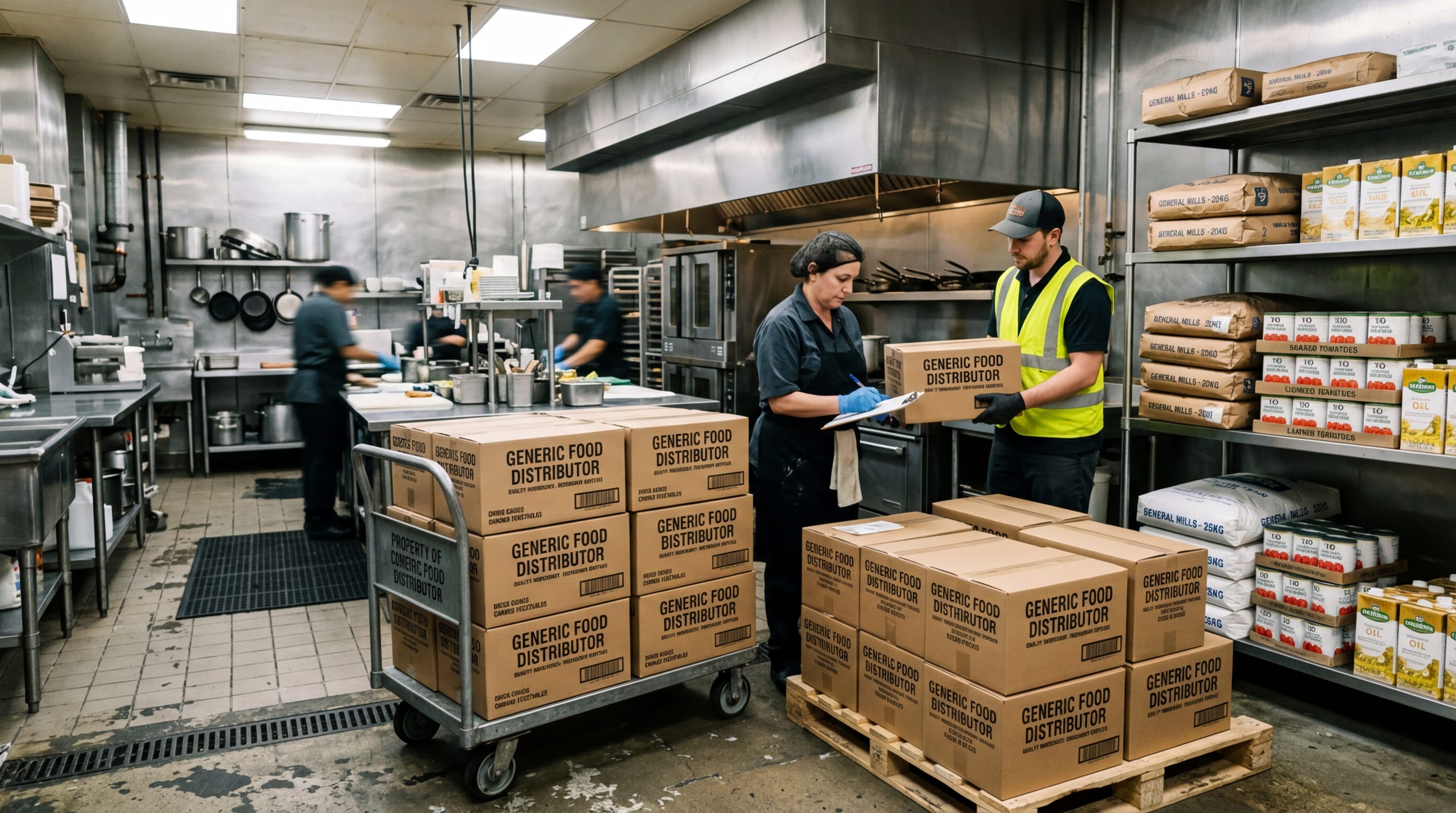
That line feels less philosophical and more literal now.
A lot of restaurants today are assembling. Not because they want to, but because the system makes it easier to assemble than to cook.
No one wakes up and decides to be mediocre. It happens one decision at a time. A substitution here. A vendor change there. A private label product that is “good enough.” A decision to simplify ordering. A decision to trust the system.
Each decision makes sense on its own.
Together, they flatten the industry.
You end up with twenty restaurants on a street, fifteen different menus, and a surprising amount of overlap underneath. You think you’re choosing between places. You’re choosing between different edits of the same catalog.
That’s the real impact of this deal.
Not that everything becomes identical overnight. That’s too simplistic. The restaurant business is too chaotic for that. The impact is more subtle and more permanent. The middle gets flatter, faster. More private label. More standardized inputs. More menu engineering driven quietly by distributor economics instead of taste.
The top will still exist. The places that care about sourcing, that build real relationships, that are willing to do it the hard way, they’ll survive. They might even benefit, because differentiation becomes more valuable as everything else converges.
But they become rarer. More expensive. Harder to sustain.
The independent middle, the part of the industry that made restaurants interesting in the first place, is what gets squeezed.
Sysco is not doing anything irrational here. If anything, this is exactly what a smart operator at scale should do. Expand distribution, capture more volume, reduce friction, own more of the customer relationship.
But smart for Sysco is not the same as good for the industry.
That distinction gets lost.
Because this isn’t really about Sysco. It’s about structure. And structurally, this moves the industry one step closer to a reality where the distributor has more influence over what ends up on the plate than the chef or the owner.
We’ll keep talking about ambiance. We’ll keep talking about vibes. We’ll keep arguing about influencers and portion sizes.
Meanwhile, the more important shift is happening underneath.
The rooms will keep getting better.
The food, less so.
Luis Mata
www.flavorandfounders.com