


You can barely open LinkedIn or Instagram anymore without someone telling you that AI is changing the game. Let Claude be your CFO. Give ChatGPT your financial statements. Let an agent run your numbers. Build an autonomous finance department.
I understand why a lot of finance people roll their eyes. I do too.
Finance is too important to leave unattended. AI is not going to make the hard capital-allocation decision for you. It is not going to decide whether you should close a location, hire ten people, raise money, cut expenses or live with lower margins for another six months. Those decisions require context, judgment and, often, a willingness to make a call when none of the options are particularly good.
AI can also be wrong, dangerously wrong…. because it is often wrong but the results looks right. It can pull the wrong number from QuickBooks, misunderstand an account, use the wrong date, double-count something or build a formula that is logically coherent and financially incorrect. The dashboard can look great and the number can still be wrong.
I know because I have spent the past month and a half building this stuff and this happened a lot… and after six weeks of doing that at Meat N’ Bone, I think the AI hype in finance is both overstated and understated. No, Claude is not your CFO. But the economics of building financial capability have changed dramatically, and I think smaller businesses may be the biggest beneficiaries.
Meat N’ Bone is a good example because we are exactly the kind of company that historically sat at a disadvantage. We have essentially one person in accounting and one person in finance. They are both constantly swamped, they carry more responsibility than their titles would suggest, and they are relatively junior for the breadth of work they have to handle. Above them are a CEO, CFO and COO who are also busy operating the rest of the company.
What we do not have is a large FP&A team sitting around asking interesting questions about the business. We do not have internal auditors reviewing every transaction. We do not have a business-intelligence team waiting for someone to ask for a three-year vendor-spend analysis before a negotiation tomorrow morning.
And yet we compete, one way or another, with companies that do.
Think about the resources available to Amazon or Chewy, or even a much larger incumbent in our own category such as Omaha Steaks. Companies at that scale have analysts, developers, finance teams and people whose job is simply to understand what is happening in the business. Scale has always bought more than purchasing power and brand recognition. It has bought organizational intelligence.
Historically, a smaller company could be just as curious, but curiosity did not create more hours in the day.
That is the part AI is starting to change.
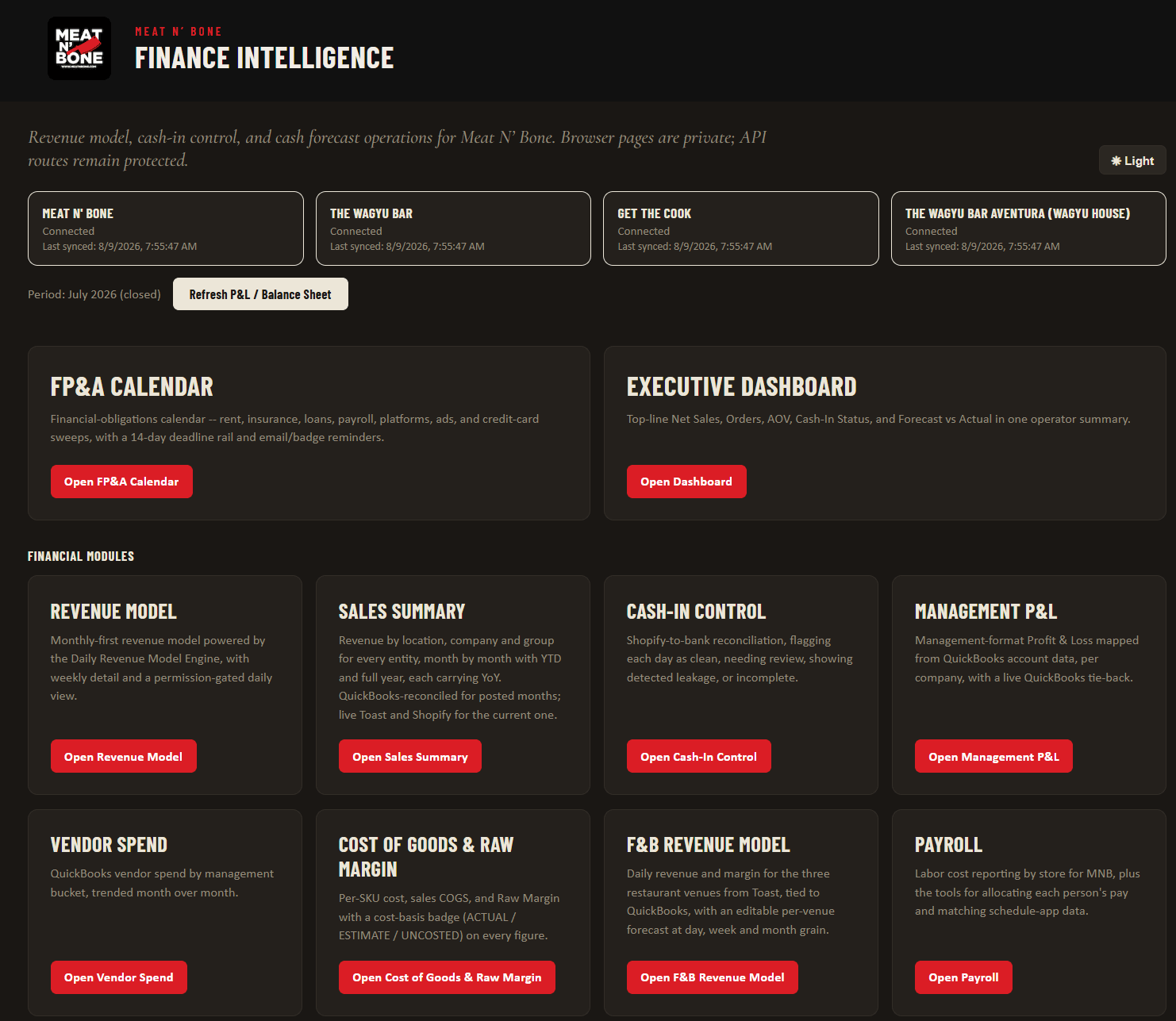
What began as a few experiments for me has turned into an internal FP&A platform that now touches revenue forecasting, sales analysis, cash controls, management P&Ls, vendor spend, cost of goods, raw margin, payroll, AP and AR, balance-sheet consolidation, loans and even controls around changes made to accounting periods that were already closed.
I would put the technology stack we have built at Meat N’ Bone up against almost anyone in our category. That is not because we suddenly hired a large engineering team. It is because the cost of building useful software has fallen dramatically.
Our revenue model is probably the best example. We had run versions of it in Excel for years. It worked, but it had become large, complicated and increasingly difficult to manage (that sheet that calculates for 45 seconds when you switch tabs). It had multiple tabs, assumptions, formulas, historical periods and dependencies… and ith ad limitations, the model was by month because going deeper made the workbook cumbersome.
The new version runs by day.
We can forecast revenue for an individual day and then roll those days into weeks, months and years. We can work with much more granular drivers and build analysis that would have been painful to maintain in the old model.
Claude Code helped me build it, but saying Claude Code built our revenue model would be misleading. I had to know what the model was supposed to do. I had to compare it against history. I had to catch outputs that made no economic sense. I had to keep checking the logic… for weeks. Even as of today I am still testing it.
The difficult part was not getting AI to write code. The difficult part was getting the numbers consistently right.
AI makes it much easier to build. It does not eliminate the need to know whether what you built is correct.
That is why we have spent so much time on checks. Totals need to tie. Balances need to reconcile. Data coming from another system needs to agree with the source. If two calculations should produce the same answer, we compare them. If something changes in a period that was already closed, we want to know. If the system cannot reconcile something, I would rather it flag the issue than explain it away.
That is also why I do not believe in the idea that you can simply hand finance over to an AI agent… But I do absolutely believe business leaders should be pushing their finance teams, bookkeepers and accountants to figure out how to use these tools.
The biggest gains are often not particularly sophisticated. They are questions that finance teams have always been able to answer, but that historically required someone to stop what they were doing and go answer them.
Did we pay a bill twice?
How much did we spend with this vendor this year?
How does that compare with last year?
I am negotiating with this supplier tomorrow. How has our spend changed over three years?
If spending increased, was it because prices went up, because we bought more, or because the mix changed?
None of these are revolutionary analyses. The problem was never that the answers were impossible. The problem was that there was a transaction cost attached to asking.
Someone had to pull the data, clean it, run the analysis, check it and send it back. Maybe it took 30 minutes. Maybe an hour. Maybe the person was busy and you got the answer tomorrow.
Over time, management starts filtering its own questions: Is this important enough to bother someone with?
That filter begins to disappear when the analysis is always available.
Vendor spending can be permanently visible. Duplicate-payment checks can run continuously. Year-over-year comparisons do not need to become assignments. A price-volume-mix analysis can live inside the system instead of being rebuilt every time someone wants to know what actually drove growth.
And when answers become cheaper, people ask more questions.

I think that matters much more to a smaller business than to a large corporation. Amazon already has the people who can answer these questions. A four-location restaurant group probably does not. A regional retailer probably does not. A 30-person e-commerce company probably does not.
For those businesses, AI is not just about making an analyst 20 percent more productive. It is about having access to capabilities that were previously uneconomic.
A restaurant operator can increasingly build systems that monitor labor by location, compare vendor pricing, flag unusual invoices, reconcile cash and watch food costs without hiring a full FP&A team. A retailer can analyze store performance, vendor trends and margins without waiting for someone to build a one-off spreadsheet. A smaller company can get much closer to the analytical capability of a larger one without recreating its organizational chart.
That is where some of the talk about AI as another industrial revolution starts to make more sense to me.
I still think the phrase is overused. But industrial revolutions are ultimately about leverage. Machines allowed fewer people to produce more physical output. Computers gave individuals access to computing power that once belonged mainly to institutions. AI may be doing something similar with knowledge work. The important shift isn’t that Meat N’ Bone suddenly becomes Amazon. It’s that some of the analytical capabilities that once required an Amazon-sized organization no longer require an Amazon-sized organization.
It is making organizational capability less dependent on organizational size.
There is an interesting implication here for something I have historically been skeptical of: the fractional CFO.
I have always struggled with that term because a CFO has to understand the business. The CFOs I have seen fail over my career were often perfectly competent finance people who never really understood the operation they were working inside. They could read the numbers, but they never got their heads into the business producing them. They butted heads with operations and sales, constantly. The good CFOs? they used their data and financial acumen to get everyone to row in the same direction.
That problem is even harder to solve when someone is only spending a few hours a week with a company.
But if a fractional CFO can now come in and do more than review the P&L, if they can help a smaller company build financial infrastructure, automate controls, make recurring analysis permanently available and leave behind systems that improve the organization after they are gone, then the value proposition becomes much more interesting.
The same applies to internal finance teams. The standard should go up.
For decades, too much finance work has been spent preparing information so someone could finally analyze it. Download the data. Reconcile it. Clean it. Put it into Excel. Update the model. Check the formulas. Prepare the report.
Then the CEO asks why margin declined.
The interesting work starts at the end.
If AI can handle more of the gathering, checking and first-pass analysis, then I should expect finance people to spend more time understanding the business. Do not just tell me labor increased. Tell me whether it was hours, wages, overtime or weak sales. Do not just tell me vendor spend increased 20 percent. Tell me whether it was price, volume or mix. Do not tell me cash gets tight six weeks from now. Tell me why and what we can do about it today.
That does not make strong finance people less valuable. It makes them more valuable.
So I would not tell a controller, accountant or bookkeeper that AI is coming for their job. I would ask them what they do repeatedly, which reports consume their time, which mistakes they keep finding and what questions management is constantly asking. Then I would pair them with whoever is technical enough to start building.
The finance person does not need to become a developer, and the developer does not need to become a CPA… but a CPA can definitely use Claude Code as their personal developer… but at the end of the day, they need to work together because one understands how to build the system and the other understands when the system is wrong.
I still would not let Claude be my CFO. I would not let it close my books unattended, and I would not trust an important number simply because an AI system produced it.
But I also would not run a finance function today without pushing the team to figure out how to use it.
At Meat N’ Bone, we do not have the finance or technology resources of many of the companies we compete with. We probably never will. What has changed is that we increasingly do not need the same number of people to build some of the same capabilities.
That, to me, is the part smaller businesses should be paying attention to. Not whether AI replaces your CFO, but whether it lets ten people do things that used to require fifty.
Luis Mata
Luis Mata is the CEO and co-founder of Meat N’ Bone, CFO & Partner of Olos Impact, and partner of Standard & Scale. He writes about food, founders, capital, technology, and the operating systems behind growing companies.