



Every so often, I call one of a few friends who are also entrepreneurs. Adri, Paco, Victor. Sometimes they call me. We call it “Founder’s Therapy”.
It is almost always one-on-one. There is no agenda. We catch up, talk about whatever is happening in the business, complain a little, give each other advice and laugh.
I have come to value those conversations because entrepreneurship can be surprisingly lonely. There are things you cannot really discuss with employees because your anxiety should not become theirs. There are things you do not want to bring home every night. Investors and board members can be helpful, but those conversations have a different purpose. Sometimes you just want to talk to someone who understands the weirdness of having a good month and still worrying about cash flow.
The details are different for all of us. Someone is dealing with churn. Someone needs capital. Someone has a good product but not enough traction. Another founder is watching a market become more competitive. One of them has no idea about financials.
In my case my problem remains the consequences of the fire. As you know, in December 2024, a significant part of Meat N’ Bone burned down. We have spent the better part of the last two years recovering from that fire, and today I carry more debt than I would like.
When we talk about how things are going, there is a phrase that seems to capture where most of us are:
A little bit less fucked.
We laugh because it is funny. But there is something real behind it. Six months later, most of us still have problems, just not always the same ones. The thing that once felt existential has been solved, contained or better understood. Even my post-fire recovery looks very different today. We are out of the woods and executing on growth.
That is progress.
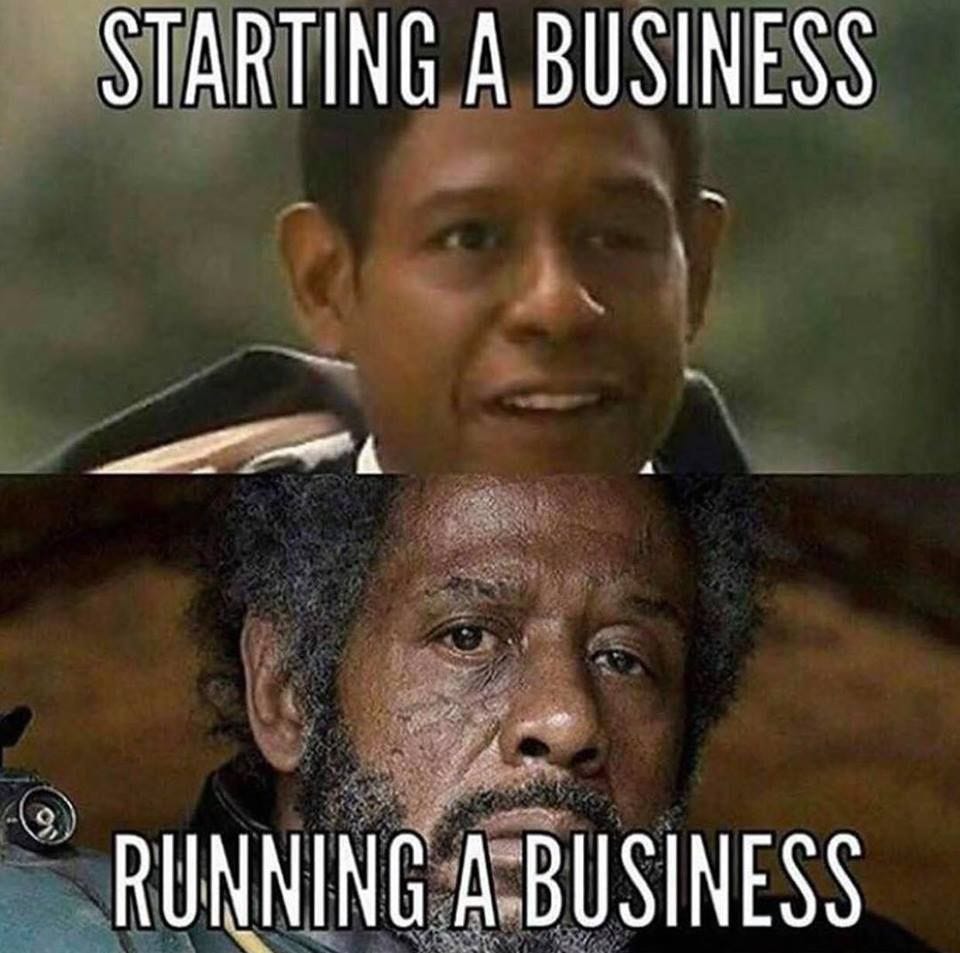
The Struggle Is Not Failure
Ben Horowitz, who built Opsware through the collapse of the dot-com bubble before eventually selling it to Hewlett-Packard, calls this period “The Struggle.”
It is the part of building a company when the problems follow you home, when you question your decisions and sometimes yourself, and when there is nobody above you to hand the problem to.
His distinction is important: “The Struggle is not failure, but it causes failure.”
I understand that much better today.
The fire left Meat N’ Bone carrying debt we would not otherwise have. It destroyed inventory and equipment, disrupted operations and forced us to rebuild things we had already built once.
But the business itself kept improving. The company grew. Our margins improved. We became better operators. Our unit economics work, and the underlying business model works.
That experience changed the way I look at companies.
We tend to evaluate businesses as snapshots: revenue, EBITDA, valuation, capital raised, headcount, profitability. That is what we have been thought… to think like a bank. We ask for guaranteed returns and collateral as if reward was not tied to risk.
But entrepreneurship is not a photograph. It is a movie.
A company carrying more debt can still be healthier than it was before. A company losing money can be moving quickly toward profitability. A business doing $50 million in revenue can be deteriorating while one doing $5 million is quietly figuring out the economics that will allow it to become much larger.
The snapshot matters. So does the trajectory.

What becomes more interesting is what happens when the ambition gets larger.
Opening an ice cream shop, a bakery or a neighborhood restaurant is entrepreneurship. It takes courage and capital, creates jobs and can build tremendous wealth for a family or be a massive headache.
But there is a different game you choose to play when you decide you want to build a $10 million, $20 million, $50 million or $100 million company, particularly when you are trying to take market share from incumbents many times your size.
To achieve that scale, you usually need investors, debt and a more sophisticated capital stack. You need more people, more systems and more infrastructure. Decisions become more expensive, and mistakes become harder to unwind.
You have to learn how to run it while you are building it.
What the Job Teaches You
Jeff Bezos once described failure and invention as “inseparable twins.” If you already know something will work, you are not really experimenting.
That is not particularly controversial. Every growing business makes investments before knowing exactly how they will turn out. You hire ahead of demand, enter markets, build systems, develop products and occasionally get things wrong.
The person capable of getting a business from zero to $1 million is not automatically capable of taking it to $10 million. The executive who can run a $10 million organization may be completely unprepared for what happens at $50 million.
So the job changes you.
One of the biggest differences, at least for me, is that corporate America teaches you to color between the lines. That is not necessarily a criticism. Good companies have structures, processes, budgets, departments and people with clearly defined responsibilities. The lines already exist, and much of the job is learning how to operate effectively inside them.

Entrepreneurship is different because very often there are no lines.
Sometimes you have to draw them. Sometimes you have to ignore the ones that already exist. And sometimes the only way forward is to color completely outside of them.
There is no department to hand the problem to. No established process that guarantees the answer. No precedent telling you whether opening the location, launching the product, raising the money, changing the model or entering the market is the right decision.
You still have to decide.
At first you learn to sell because nobody knows who you are. Then you learn to hire because you cannot do everything yourself. Eventually you learn to fire because some people who helped you reach one stage will not be right for the next one.
You learn accounting because cash and profit are different things. You learn finance because growth consumes capital. You learn operations because improvisation stops working at scale. You learn technology because eventually the spreadsheets break. You learn leadership because managing five people and building an organization of fifty are fundamentally different jobs.
Then there are the lessons nobody planned for: lawyers, insurance, banks, investors, difficult partners, supply chains, recessions, pandemics and, occasionally, fires.
You learn them because the problem is sitting on your desk and there is nowhere else for it to go.
Phil Knight understood this early in Nike’s history. Long before Nike became inevitable in the popular imagination, Blue Ribbon Sports was chronically short of cash. Knight considered what would happen if the company failed and realized that, although he could lose the business and his money, he would leave with something he described as “valuable wisdom” that he could apply to whatever he built next.
He considered that wisdom an asset.
I do too.
The Asset We Don’t Measure
Before becoming an entrepreneur, I spent roughly twenty years working in corporate America. I worked around sophisticated organizations, investors and talented executives. I learned finance, strategy and management. I went to business school. Those experiences gave me much of the foundation that allowed me to build Meat N’ Bone.
But I have learned more about running a business during the last five years than I did during the previous twenty.
The difference is consequence.
Inside a large organization, there are structures around you. There are departments, specialists, budgets, established processes and institutional knowledge. When something falls outside your expertise, there is usually somebody whose expertise it falls inside.
As an entrepreneur, eventually everything becomes your problem.
When sales decline, you have to understand why. When margins deteriorate, you have to find the leak. When cash gets tight, strategy gets tested very quickly. A financial problem turns out to be operational. An operational problem turns out to be about people. A technology problem turns out to be a process problem.
Sometimes you know the answer. Often you do not.
So you call someone smarter than you. You read. You ask questions. You make a decision with incomplete information and live with the consequences.
Do that for long enough and your judgment changes.
Today, I genuinely believe I could walk into almost any company, sit on almost any board or work alongside almost any management team and be an asset. Not because I would know their business better than they do, and not because I have all the answers. I am simply much better at figuring things out.
I can look at a P&L and then walk into the operation and ask why it looks that way. I understand how quickly strategy collides with cash flow, how incentives affect behavior and how problems that look unrelated are often connected. I also know when I need someone who knows more than I do.
Most importantly, I am much harder to scare than I used to be.
There is no line for that on a balance sheet, but it is an asset.
We spend enormous amounts of time measuring what entrepreneurship creates: revenue, EBITDA, enterprise value, jobs, customers and shareholder returns.
We spend much less time measuring what it creates in the entrepreneur.
That may be why I keep looking forward to Founder’s Therapy. We call each other to talk about our companies, but over time I have realized that we are also watching each other become better operators. The problems change, and so do we.
The companies may end up exactly where we hoped. Some may not.
But there is something we get to keep.
For years, I thought I was building a company.
It took me a while to realize that the company had been building me too.
Luis Mata
Luis Mata is the CEO and co-founder of Meat N’ Bone, CFO & Partner of Olos Impact, and partner of Standard & Scale. He writes about food, founders, capital, technology, and the operating systems behind growing companies.